

[Editor’s note: This transcript was generated using both transcription software and a human’s light touch. It has been edited for style and clarity.]
Julie Rovner: Hello from KFF Health News and WAMU public radio in Washington, D.C. Welcome to What the Health? I’m Julie Rovner, chief Washington correspondent for KFF Health News, and, as always, I’m joined by some of the best and smartest health reporters covering Washington. We’re taping this week on Thursday, May 14, at 10 a.m. As always, news happens fast and things might have changed by the time you hear this. So, here we go.
Today, we are joined via videoconference by Lauren Weber of The Washington Post.
Lauren Weber: Hello, hello.
Rovner: Rachel Cohrs Zhang of Bloomberg News.
Rachel Cohrs Zhang: Hi, everybody.
Rovner: And Alice Miranda Ollstein of Politico.
Alice Miranda Ollstein: Hi.
Rovner: Later in this episode, we’ll have my interview with Wisconsin Democratic Sen. Tammy Baldwin. But first, this week’s news.
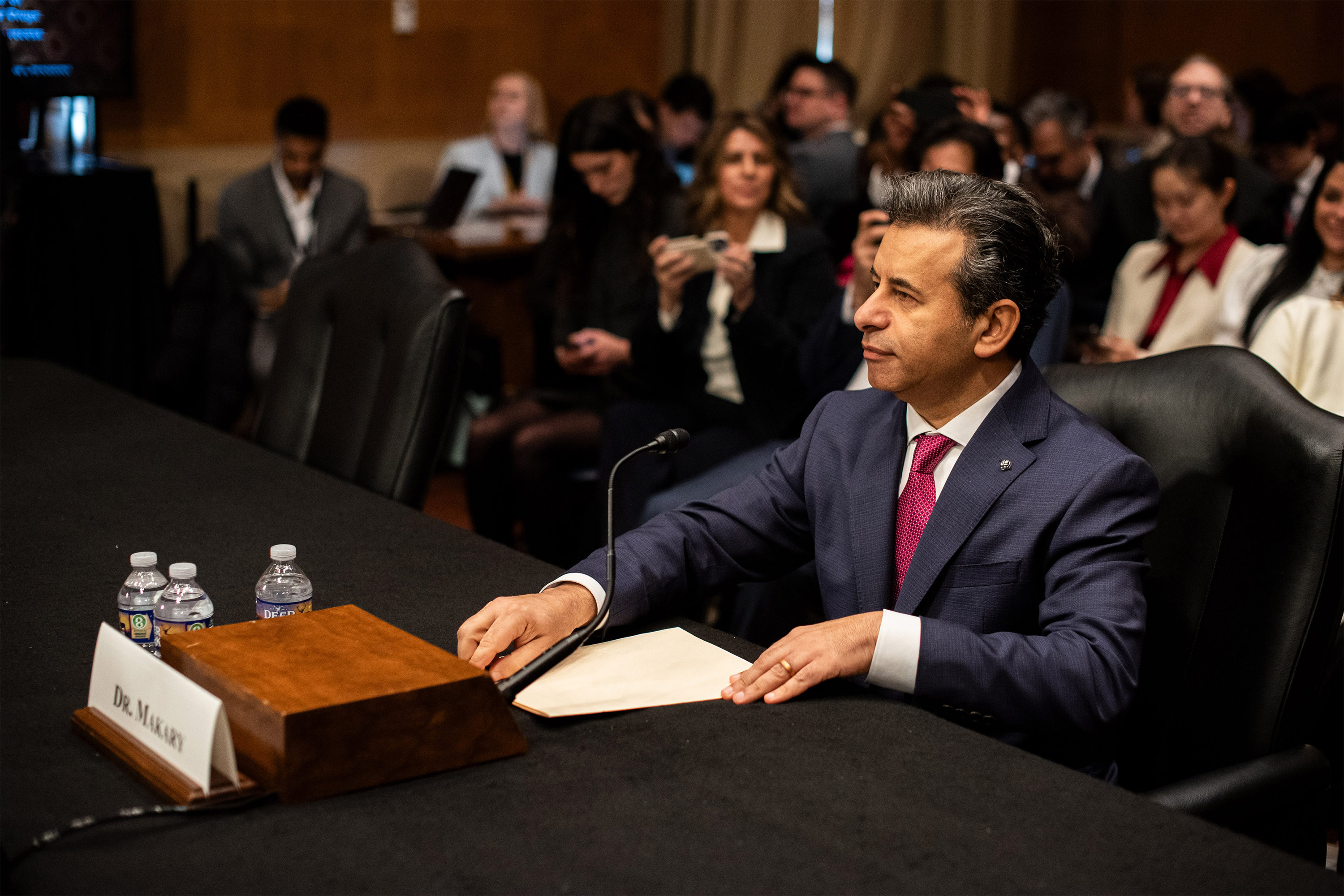
Well, as we foreshadowed last week, Marty Makary’s tenure as commissioner of the Food and Drug Administration has come to an end. It’s not entirely clear whether he was fired or whether he resigned or whether he was forced to resign, but what is clear is that his 13-month tenure at the helm of the agency that regulates $1 of every $5 worth of consumer products in the U.S. was chaotic, to say the least. Quoting from the excellent Wall Street Journal story on his exit, “He had upset advocates for vaping and rare-disease patients, antiabortion groups, and some drug-industry leaders — as well as other officials in the administration.” Rachel, you’ve been following this story very closely and breaking a lot of news on it. Who didn’t Marty Makary piss off? And tell us more about that Wall Street Journal ticktock of his last few days, since it’s your “extra credit” this week.
Cohrs Zhang: It is my extra credit. Truly nothing scares me more than seeing Josh Dawsey’s byline on a story on my beat. So I think the tension with Dr. Makary had been going on for months. I think there was kind of an effort that bubbled up, kind of last fall, in November, about — that raised some questions about his future and just his ability to cooperate. But he was able to keep his job at that point in time. But I think there have been a lot of changes at HHS [the Department of Health and Human Services] this calendar year, and I think there’s been an effort to kind of stabilize things, start to get people in place for some of these other positions, at surgeon general and at CDC [the Centers for Disease Control and Prevention]. And once those personnel searches started wrapping up, I think it shifted the focus back, I think, to FDA a little bit more, and there’s a lot of drama coming out of there.
And I think there is certainly a desire from the White House to get wins out of their agencies to tout, and especially ahead of the midterms, they just want people to be on message and to not have distractions. And I think the FDA, under Dr. Makary’s tenure, just continued to produce distractions. And there was personnel issues. There were certain policy issues that he was not necessarily aligned with the White House on. But there’s also just internal dynamics. When you’re leading an organization, you’re coming in after DOGE [the Department of Government Efficiency], it takes a lot of work to build trust back with career staff who saw their bosses fired, their colleagues retiring. It’s — there was so much turnover.
Rovner: And I was going to say, FDA took a big hit from DOGE, didn’t it?
Cohrs Zhang: It did take a big hit.
Rovner: This was before Makary came in.
Cohrs Zhang: Yes, technically before he came in. But I think we’ve seen other agencies — certainly not the level of turnover we saw at FDA — but try to build bridges and speak positively about career staff and really make an effort to value their expertise and bring them in the room. And I think we just didn’t really see that at the FDA. I think there was just mistrust and genuinely a view that we hear in public sometimes that career staff, or the “deep state,” weren’t supportive of the administration’s goals. And I think ultimately just the culture becomes toxic enough, and it’s just a difficult work environment for people doing really important work.
Rovner: And people, the stakeholders at FDA, are really important people, many of them.
Rachel Cohrs Zhang: They are. It cuts across so many different industries, like tobacco, food, medical devices, drugs, Big Pharma, small biotech. Truly, it’s a tough job to balance all the stakeholder interest. But I think if there had been a sense that he was really taking on industry and pursuing needed reforms, I think that would have been OK. But I think it was just communication issues, unpredictability. It’s just investors, companies don’t like unpredictability. They don’t like surprises, especially kind of a regulator that usually is pretty — has a lot of continuity from one administration to another.
Julie Rovner: Well, it seems like the last straw, as we discussed last week, was this fight over vaping — in particular, fruit-flavored vapes, which might help adults quit more-dangerous tobacco products but also might attract children to start vaping. Makary was against the fruit-flavored vapes. [President Donald] Trump had promised the vaping industry during the 2024 campaign that he would protect them. Is there going to be more fallout from this whole vaping fight? I did see that a top HHS spokesman quit this week, also citing approval of the fruit-flavored vapes. But there’s more to that story, too. Right, Rachel?
Cohrs Zhang: Yeah, I think personnel issues are really hard to cover, and the context that I would want to provide is that these resignations, both of Dr. Makary and the HHS communications chief, Rich Danker, were not resignations where these individuals had the possibility of a long and robust career at these agencies. I think they both kind of reached the end of the line. And certainly, are there policy disagreements that occurred about fruity-flavored vapes? Absolutely, yes. But those dynamics have been ongoing for a long time. I think it’s also important to point out that the agency did approve these before the exit of both of these officials. And I think there’s just, the timeline, it’s a little complicated. Personnel issues are complicated, but I think, again, the Wall Street Journal story by Liz [Essley Whyte] and Josh did a really good job of trying to get that 360 view and kind of explain it in a fair and balanced way as to how that all went down.
Rovner: So the question that this keeps leaving in my mind is: How is tobacco not a bigger piece of MAHA? If we’re going to “Make America Healthy Again,” isn’t the first thing we want to do is get people to stop using tobacco products? Why is this out in this sort of little island by itself, when [Health and Human Services Secretary] RFK [Robert F. Kennedy] Jr. is beating up on pretty much everything else?
Cohrs Zhang: That is an interesting point. Calley Means at the White House also did a conversation with Harvard this morning and just kind of mentioned that they’re not trying to ban anything in the administration. That was kind of the talking point they were using: We’re not banning cigarettes. We’re not banning ultraprocessed food. We’re just trying to educate people on what’s good or bad for you. So that’s kind of the line they’re taking.
Rovner: So it’s like vaccines? It’s like everything should be up to your choice about what you put in your body?
Weber: I just wanted to add that, Julie, I feel like you’re asking a question of the MAHA movement the MAHA movement is unable to answer, which is: What is the MAHA movement? If we care so much about chronic disease, why aren’t we looking at one of the things that kills people a lot, which is tobacco? So, which leads also, and we’ll get to it later, to my extra credit, which is on Stat’s excellent series on alcohol, which the administration is also not really looking at. So I think when MAHA talks about these underlying pillars of combating the chronic disease epidemic, that’s all great. But what are they defining as the chronic disease epidemic? Because a lot of their attention has been focused on vaccines, which scientists have very clearly stated are not causing the chronic disease epidemic. So, we’ll see how this continues to unfold.
Rovner: And reversing the food pyramid, to emphasize things that science has shown do contribute to chronic disease, like lots of animal products. So it’s a little bit curious, let us say. Well, the person who is now installed to replace Dr. Makary, at least on an interim basis, isn’t even a doctor. He’s a former corporate lawyer at the firm Jones Day and a hunting partner of Donald Trump Jr.’s. What else do we know about Kyle Diamantas, who’s been heading up FDA’s food division?
Ollstein: So the anti-abortion groups that were demanding Makary’s ouster, some of them, over accusations that Makary was not doing enough to restrict access to abortion pills, are already worried about the acting replacement because records surfaced showing that he represented Planned Parenthood as a private attorney a decade ago, and so —
Rovner: In a real estate case, right?
Ollstein: In a real estate case, in a dispute between a clinic and its landlord. So clearly this was a concern, because within hours of his appointment as acting FDA leader, he was on the phone with anti-abortion groups, and he’s been talking to them on Tuesday, on Wednesday, on Thursday, different groups, trying to reassure them that he personally opposes abortion and will work with them going forward. But I think if he is nominated to lead the agency on a more permanent basis, that could potentially become a flash point.
Rovner: And of course, we do know, Rachel, I think you were breaking this morning that the idea of him replacing Makary on a more permanent basis is already not going over very well in the Senate.
Cohrs Zhang: Yeah, I think Sen. Bill Cassidy made some comments about Kyle. And I think there is absolutely a permanent search. I am not under the impression that they are planning to nominate Kyle Diamantas to be the permanent leader. I think they are searching for somebody with more robust expertise. But I think he’s just made a lot of allies. He’s been a pretty predictable and rational actor in the FDA. He got promoted earlier this year to be an adviser. He’s been doing public appearances, conferences, and on podcasts and television. So I think they just see him as a kind of a steady hand to guide the agency and not cause a lot of drama going into the midterms, because there’s a big backup of nominations in the Senate. So this could drag on for a while.
Rovner: Right. That is my next question. Who is likely to get this job permanently? And, wow, the nominations are stacking up at the Senate HELP [Health, Education, Labor, and Pensions] Committee, where chairman and troubled Trump ally Bill Cassidy now has to oversee the confirmations of a new FDA commissioner, a new CDC director, and a surgeon general. And Cassidy himself is facing a primary election this weekend in which the president has endorsed one of his opponents. Awkward much?
Cohrs Zhang: Yeah, it’s an interesting test of some of this proof of concept. Secretary Kennedy’s political operation has backed congresswoman Julia Letlow and so has the president. So there are these bigger macro issues of loyalty to the president and kind of where the Republican Party is headed. But there is a distinct healthcare flavor to this, given Sen. Cassidy’s influence over health policy in the Senate, and also just the involvement of a sitting Cabinet secretary’s political operation, which is pretty unusual, especially countering a sitting senator from his own party. So, yeah. It’ll be interesting to watch on Saturday.
Rovner: Lauren, you want to add something.
Weber: I want to call out again that Trump and RFK and Calley Means went pretty scorched-earth on Cassidy when they pulled Casey Means out, too. It’s not just that Trump has opposed him. It’s that this is like blow-everything-up-on-the-field oppose Bill Cassidy. So it is very curious to hear how this goes over, considering that Cassidy was the vote that got RFK his secretary post. So the weekend will be one to watch.
Rovner: Yeah, it will. Well, the other big story from last week that continues this week is also FDA-related. It’s the fate of the abortion pill mifepristone and whether it will continue to be available via telehealth prescribing. The Supreme Court last week put a temporary hold on a 5th Circuit Court of Appeals ruling that would have rolled back the tele-prescribing option. We were supposed to get a decision on whether or not that appeals court ruling would take effect by the end of the day Monday. But, as we so often say in Washington, that did not happen. Alice, where are we with this case?
Ollstein: We’re in a real hurry-up-and-wait situation. I had all my pre-writes ready to go on Monday, and I still have them ready to go for today. Look, the Supreme Court could punt again. They could say we need even more time. That’s happened before. They could say that the nationwide restrictions that the 5th Circuit put into effect that would cut off telehealth access to abortion pills and mail delivery of abortion pills and reinstate a prior rule saying patients can only get the drugs in person from a doctor, they could let that go into effect. Or they could say, Look, we’re going to maintain the status quo for now while this case makes its way through the courts. Those are sort of the three options. There could be a secret fourth thing. This is the Supreme Court. They kind of do what they want. One possibility is some parties in the case have asked the Supreme Court to leapfrog the 5th Circuit and just deal with this themselves once and for all. So that could happen, or they could send it back down to the 5th Circuit.
We can sort of take some clues from what they did when a different case challenging abortion pills came before them in 2023, which is: They maintained the status quo. They maintained nationwide telehealth access while sending the case back to the 5th Circuit. And then it eventually came back to the Supreme Court, and they eventually sort of dodged the heart of the issue and decided it based on standing. That could happen again here, too. We have no idea. But this is really a major case because if these nationwide restrictions on telehealth go into effect, it’ll be really the biggest rollback of access since Roe v. Wade was overturned in 2022. And it will really go after access in blue states with protections on the books for abortion access in a way that people in those states really haven’t experienced before now, which could have very big political as well as healthcare implications.
Rovner: And which those states have also sued.
Ollstein: Yes. Yes, yes, yes.
Rovner: The blue states. So there’s more to come. What role if any did the anti-abortion movement have in Dr. Makary’s losing his job? As we discussed last week, they blamed him for the FDA’s slow-walking of a review of mifepristone safety, even though it’s pretty clear that that delay came from the White House, not from Makary himself. And I know there was a White House meeting just last Friday with anti-abortion groups, just as the Makary-is-on-his-way-out rumors began to fly in earnest. Connected?
Ollstein: So the administration is definitely trying to reassure the anti-abortion movement and keep them in their good graces leading up to the midterms. But that’s not entirely been successful. The anti-abortion groups are still upset. They still want to see these policy actions. They want the FDA or the DOJ [Department of Justice] or the EPA [Environmental Protection Agency] or some agency to do something to cut off access to abortion pills. They have not gotten that yet. They’re also really upset that the current ban on Planned Parenthood receiving Medicaid funding is set to expire in July, and it’s not totally clear Congress is going to manage to extend that defunding provision at all or in time for its expiration. And so these are two big priorities of theirs that they are very upset about. And so it’s not clear that all of this access that the administration is extending to them in these meetings and these phone calls, if that’s not followed up by concrete policy action, they’re not going to be satisfied. They’re going to keep complaining, loudly, as we’ve already seen this week.
Rovner: Well, meanwhile the Trump administration used Mother’s Day this week to unveil a new regulation aimed at making it easier for employers to offer IVF [in vitro fertilization] coverage to their workers, though not making it free, as Trump had promised on the campaign trail in 2024. And at a maternal health event on Monday in the White House, administration officials continued to press their pro-natal push for more people to procreate. Here’s how [Centers for] Medicare & Medicaid [Services] chief Dr. Mehmet Oz put it at the event.
Mehmet Oz: One in 3 Americans are under-babied. What does under-babied mean? That means that you either don’t have any children or you have less children than you would normally want to have.
Rovner: Um, OK then. This event also featured the unveiling of a new federal website, moms.gov, which HHS says is a, quote, “user-friendly, one-stop digital hub providing new and expectant mothers with essential resources.” But it also links users to an anti-abortion group site that collects lots of sensitive personal information that can apparently be used any way the group, Heartbeat International, sees fit. Alice, this has prompted some concern in the reproductive health community. Has it not?
Ollstein: It has, and it’s also a good example of how the administration is both working to appeal to anti-abortion activists while also continuing to piss them off, disappoint them. And so there was just a lot of mixed reaction to the unveiling of this website, because the anti-abortion folks were thrilled that it was steering people, using government resources to steer people to these often faith-based, anti-abortion crisis pregnancy centers. But at the same time, it was promoting IVF, which many of them oppose. They see it as akin to abortion. They — some see it as even worse than abortion, because it’s creating all these embryos and discarding them. And so it’s this real sort of push and pull where they’re not happy and, as you mentioned, the pro-abortion-rights camp is really not happy, either.
Rovner: So we will have more of this as we go forward. All right, we’re going to take a quick break. We will be right back.
So back in February —I looked this up — we talked about the Trump administration threatening to withhold millions of dollars appropriated to the global childhood vaccine group called Gavi, because it wouldn’t promise to phase out the use of the preservative thimerosal, which, by the way, has long since been cleared of accusations that it causes autism. The U.S., which helped create Gavi, now owes it $600 million — $300 million each for the last fiscal year and the current fiscal year. And last week, a bipartisan group of senators, led by Senate Appropriations Chairwoman Susan Collins of Maine, sent a letter to Secretary of State Marco Rubio asking him to, you know, spend the money that Congress appropriated. Now, Gavi says it has specific reasons for using vaccines with preservatives, because it mostly operates in poor countries, where refrigeration can be spotty, and it has to make the best use of limited funds. My bigger question is: How does the secretary of Health and Human Services get to stop the State Department from spending money appropriated by Congress?
Weber: I think that’s a great question, Julie. At the end of the day, Kennedy, for years — this is not something he came up with overnight. This is something he’s been harping on for years. He wrote a book about thimerosal. He has linked it to autism, which is a claim that has been disproven by scientists and even folks at his own agency, before his handpicked advisory committee voted to get rid of it, in a decision that now is on ice with the federal court. But he also has railed against the sending of these vaccines abroad for years. I’ve listened to him talk about it. He really dislikes Bill Gates for his involvement in some of this. And so on. So it was a personal issue for him that he’s held tightly. I’m not sure how you get ahold of State Department funds, but I’m not sure of a lot of things these days. So, here we are.
Rovner: Neither is Congress, apparently. We will watch the Gavi space, too. Well, meanwhile, we are also still watching this hantavirus outbreak that apparently came from Dutch tourists in Argentina, who caught it and spread it on a cruise ship in the Atlantic. So far, there are nine confirmed cases and two more people showing symptoms. Public health experts, including what’s left of the Centers for Disease Control and Prevention here in the U.S., seem fairly united in the view that while this is an odd outbreak, since hantavirus rarely spreads from person to person, they’re still not super worried about it morphing into another pandemic. But it does underscore just how unprepared the U.S. is should another outbreak of this or something else prove more dangerous, now that the nation has basically cut public health capacity to the bone, cut ties with international public health organizations like the World Health Organization, and defunded much of the federal public health infrastructure. Although, I have to add, there is at least a little bit of karma in watching all these officials who rose to prominence criticizing the nation’s covid response trying to respond to a public health emergency of their own. What are you guys watching for? Lauren, you must be on this one.
Weber: Yeah, no, I had a story earlier in the week about: What’s it like to be in the Nebraska national quarantine unit? Which it was kind of fascinating to me. So basically there’s this whole setup in the middle of the country — and as a Midwesterner, I obviously love a Midwest shout-out — where they repatriated all these people off the cruise ship and sent them to Nebraska. And you end up, basically, if you’re in the quarantine unit, in what’s essentially a souped-up hotel room. There’s an exercise bike. Apparently, the staff is very nice. But you can’t leave, really, unless — there is some talk about letting some of the people that seem to really have no symptoms potentially leave to stay at home, but it’s a little unclear what’s happening there. Staff comes in in protected masks. And you don’t get to see people for a while, so that’s kind of a tough go after you were on a cruise ship sailing the world. That really went awry. So —
Rovner: And it’s a long incubation period for this particular strain of hantavirus.
Weber: It’s a long — 42 days! That’s a long time to be stuck in a room. But again, officials — as you said, Julie, I think which was smart to point out — have said this is not covid. This does have very low risk of spreading to the general public. I do think there is some question about this question of prolonged contact and what that means — it seems like it’s being debated a little bit about how exactly this spreads and how exactly many people may end up coming down with it — that we’ll have to continue to watch as well.
Rovner: And of course, we’re already seeing people online, like, selling more ivermectin. And, this sort of thing does bring out the less-than-scrupulous actors in public health, shall we say?
Weber: Nothing like a crisis. But, in general, I think it’s a good reminder. As you pointed out, we’re watching the contrarians run the ship. I was fascinated. In the Oval Office, basically, RFK Jr. said there’s nothing to worry about, Nothing to see here kind of thing. And that is, it’s interesting, the public health messaging, which has varied from person to person in the administration, because they have litigated how covid was messaged for such a long time. Now, again, this is not covid. But it’s very fascinating to see players that had such strong opinions deal with some of the same terms, like “quarantine,” “6-feet isolation,” the uncertainty of what’s happening, and, again, deal with it in a backdrop of: We’ve withdrawn from the WHO. There have been CDC cuts. And what happens now?
Rovner: Yeah, and also the fact, and we talked about this a little bit last week, that the U.S. didn’t even know that some of the people who were exposed had already gotten off the ship and gone home. And those people are not in quarantine in Nebraska. Those people are apparently being watched by their individual state health departments. So the coordination effort here was not great, either.
Weber: Well, it does sound like the CDC was on the horn with state health officials. But yeah, I mean, some of these people kind of flew into the wind, so to speak, and they haven’t found everyone. But that said, you know, I talked to the Virginia state health official who was like, Look, we’re in talks with the patient in Virginia who … they check in for daily monitoring of temperature checks and so on. The California state health official that I listened to said, Look, these people that we’re watching were either a row behind or a row in front of, or two seats next to, for at least 15 minutes a suspected ill passenger on a plane. That’s why we’re watching them. And that’s interesting to me, too, because that speaks to the level: Is that prolonged contact? What does prolonged contact mean? is my underlying question I continue to ask. So we’ll have to continue to see what we learn more on this front.
Rovner: Well, at very least, they’re getting an idea that covid was not so easy to deal with — these people who’ve been criticizing the covid response. OK, that is this week’s news. Now we’ll play my interview with Sen. Tammy Baldwin of Wisconsin, and then we’ll come back and do our extra credits.
I am so pleased to welcome to the podcast U.S. Sen. Tammy Baldwin, Democrat of Wisconsin. Sen. Baldwin is a senior member of both the Health, Education, Labor, and Pensions Committee and the Senate Appropriations Committee, where she’s the top Democrat on the subcommittee that funds the Department of Health and Human Services. Sen. Baldwin, thank you so much for joining us.
Sen. Tammy Baldwin: Thank you for having me.
Rovner: So we spend a lot of time on the podcast talking about health issues that are divisive, and often divisive by party, but one feel-good story of the past few months comes from a study showing that the new 988 suicide prevention hotline has, in fact, reduced youth suicides. That was a very bipartisan effort in Congress that you were, I know, a big part of. How satisfying has it been to see that succeed, and is there a chance that you could repeat that work on other health issues, or was this kind of a one-off?
Baldwin: Look, I knew when we wrote the bill to establish the 988 hotline that it was going to save lives. But to have this study showing that there was 10% to 11% reduction in youth suicide and attributable to this 988 hotline — it’s heartwarming to know that this work matters. And it was very bipartisan legislation to establish the 988 hotline. You know, we’ve long had a mental health crisis suicide prevention hotline. It was a 10-digit number that no one would remember at a time of crisis and need. And so now people remember it and can use it, and it’s also modern in that you can also chat or text as well as call. And with the young generation, sometimes that’s their preferred way of reaching out and communicating. But again, heartwarming to hear what I always believed would be true about 988 — that it is saving lives and people are using it.
Rovner: I know that as much of a success as this has been, you’ve been critical of HHS Secretary RFK Jr. for eliminating the part of the hotline that provided a separate option for LGBTQ+ youth. What’s the status of your effort to get that restored?
Baldwin: Yeah, and I’ll focus on that. And there’s some other concerns that I have about the way in which we support 988. But let me start with that. There are certain populations in the United States that have higher rates of suicide. I think we all immediately think of our military veterans. And so when you call the 988 hotline, one of the first screening questions is: “Are you a military veteran? Press 1.” And if you are, you have the option then of getting your call or inquiry responded to by somebody in the VA [Department of Veterans Affairs] system who, I might say, has walked in your boots before and understands the experiences that you might have had while serving in the military. Another population with a very high rate of suicide is LGBTQ youth, and so the “Press 3” option made sure that youth who were in the LGBTQ community and reaching out for help in crisis were getting their calls and texts responded to by somebody who was specially trained and understood their situation. And you know, again, it promotes use of the line because you don’t think when you call that you’re likely to be judged. And by the way, the study that showed this was having a very positive impact on reducing suicide said that 1 in 10 calls to the 988 hotline, people utilize the “Press 3” option. But what happened there is the Trump administration last year abruptly ended the service and defended that by saying, Well, we want to treat everyone the same. We don’t want to discriminate. Well, they kept the “Press 1” option for veterans, and understanding that specialized response for veterans would be important to keep, but they eliminated the service “Press 3” for LGBTQ youth. Very unfortunate. But fortunately, there was a bipartisan pushback to that —on two fronts for that, one successful and the other still in progress. We wanted to make sure that the administration restored the “Press 3” option and restored the contracts with nonprofits that are able to provide the response to those calls. And that was written into our appropriations law for the fiscal year 2026. Now we’re chasing down the administration and Secretary Kennedy, saying, It’s in the law. Let’s get it done. It hasn’t happened yet, but we have his public commitment to make sure it does. And so we’re pressing him for expeditious restoration of the “Press 3” option. That said, we also want to make this permanent law. And so I have a bill that is bipartisan with Sen. Lisa Murkowski that would write into statute that a “Press 3” option has to exist and so that it doesn’t become political football in the future.
Rovner: Well, I’m so glad you mentioned things that have been written into the appropriations law, because one of the continuing issues that we’ve chronicled over this last year has been this administration just refusing to spend money as appropriated by Congress. Now, I’ve been covering Congress in general — and the Labor-HHS appropriation, in particular — for four decades now, and a 25-year-old or 35-year-old me could not imagine appropriators standing for any administration, ignoring their power of the purse, which this one seems to be doing. Why has there been so little pushback, and is that going to change?
Baldwin: Yeah, in answer to your question, I want to say that in this most recently passed bill that Donald Trump signed into law, we had to put guardrails that we’ve never had to put into our appropriations laws before to enforce our spending bills. And those laws have made it clear that we expect that they must spend what we have appropriated, and not just, you know, all of it at the end of the fiscal year, but in a timely manner throughout the year. And we also are more specific about staffing requirements, because we saw last year these incredible numbers of people fired, RIF’d, as well as really heavy pressure to get people to sign up to early retirements, etc., but just a big push to get people out of the agencies. And so we had to write into the appropriations law that they have to maintain staffing sufficient for their mission. And I can give you any number of examples where people needed to reach out to divisions within the CDC, for example, and no one was there.
Rovner: Is there going to be more pushback, do you think, if the administration tries this year to avoid spending money in the way that they tried to avoid spending money last year — and, as you kind of mentioned, dumped a lot of money out the door at the very end of the fiscal year?
Baldwin: Yeah, so one of the areas in which they did that in a significant way was NIH [the National Institutes of Health]. We saw thousands fewer grants awarded last fiscal year, and we’re very worried that they would continue to act in that vein. And part of that battle is still ongoing. There’s something — we’re going to get in the weeds here for a second — but there’s something they call forward funding, where instead of just annually funding one year of grant research activity, you actually fund multiyear grants all at once up-front. And the administration has wanted to move into doing that more and more and more, but if you have a finite number of dollars, that simply means fewer grants will be awarded each year. And the way I liken it, if you’re thinking about NIH and curing cancer or finding a better treatment for Alzheimer’s, these are more shots on goal. We need to not just invest in a few research endeavors to try to cure cancer, to try to treat Alzheimer’s, to deal with all of the things that NIH is trying to advance, you have to have as many shots on goal as you can. And so this forward funding is really tying up a lot of resources in fewer and fewer research endeavors.
Rovner: And that — which leads me to my last question, which is … concerns the other thing we’ve talked about a lot, is that future health care and research worker pipeline having fewer grants means fewer jobs for students and PhDs. And this administration has also made it more difficult for medical students and other health profession students to take out loans by capping the loan amount. How big a concern is this? And what can you do from your posts, either on the HELP Committee or on the Appropriations Committee, to make sure that there is a future workforce for healthcare and research?
Baldwin: Yes. Well, especially in research, I was proud to … lead bipartisan legislation called the Next Generation Researchers Act that passed many years ago but is definitely in threat under this administration. I represent the state of Wisconsin. We have a couple of academic research centers that are exceptional. And I remember visiting on so many occasions and seeing these bright postdocs looking forward to their opportunity to advance treatments and cures for devastating illnesses and learn about the basic mechanisms of biology. And knowing each year that the average age of the first-time grant awardee is getting older and older and older, and the opportunities for a career in research — which is such an investment by the individual to their education and postdoc work — their opportunities are shrinking and shrinking. And some are leaving research and going into private industry. Some are leaving the country and are actually being lured by other nations who want to take advantage of this neglect here in the United States. This is something we’ve got to turn around. And forward funding is one of the things that is making it harder, but also the lack of commitment to just increasing the overall research enterprise in the United States, which is something we are known for globally. You have to keep up with it. Costs increase, and so you can’t just flat-fund, that means less. You can’t forward-fund, that means less. So we’re going to have some bipartisan pushback, but we also are going to have a very limited amount of resources to deal with, especially — just to drop a big topic at the very end here — especially with a Defense Department that is seeking $1.5 trillion in funding — that, just the math doesn’t work out.
Rovner: Well, we will be watching the appropriations process closely as it moves forward.
Baldwin: Yes, indeed.
Rovner: Sen. Baldwin, thank you so much for joining us.
Baldwin: Thank you for having me.
Rovner: OK, we are back. It’s time for our extra-credit segment. That’s where we each recognize a story we read this week we think you should read too. Don’t worry if you miss it. We will post the links in our show notes on your phone or other mobile device. Rachel, you have already done yours. Lauren, why don’t you go next?
Weber: Yeah, I wanted to highlight Stat’s series, the first of which is titled “Alcohol Is Wreaking Havoc on U.S. Public Health. American Society Looks the Other Way,” by Lev Facher and Isabella Cueto. And it’s just a fabulous step-back look at how this administration, in particular, which would seem to be primed to look into alcohol as an addiction, considering that Trump himself is a teetotaler and RFK Jr. has publicly spoken about his recovery from addiction to alcohol, is not seizing the moment. And this is happening at a time that ER visits for alcohol are going up, and that alcohol does, speaking of chronic diseases, contribute to quite a large amount of American healthcare costs. And it’s a real bracing look at an issue that, you know, oftentimes people don’t want to look at in this way, as alcohol is such an inherent part of America’s social fabric. So kudos to them for the look.
Rovner: Yeah, I would point out that both alcohol and tobacco are, you know, two of those vices that have been bipartisan over the years. Republicans and Democrats in Congress have worked on, but this administration seems to be sort of downplaying both of them. Alice.
Ollstein: Yes, I have a piece by my colleague Katherine Tully-McManus titled “Lawmakers’ Prescription Data at Risk After Data Breach.” Now we’ve been hearing a lot about the threats to medical privacy with everything being in these electronic records, and, you know, being shared from company to company. And turns out, even being a member of Congress does not protect you from this brave new world that we live in. And there was a data breach this week that lawmakers were informed of, and potentially their prescription history was unveiled. And so that is information I am sure they do not want out there. So it just really shows that if even they can be at risk, then, you know, what’s going to happen to the rest of us?
Rovner: Yeah, that was some story. And I would add that TMZ is looking for members of Congress who smoke weed. That’s a separate story. Not my extra credit. My extra credit this week is from ProPublica. It’s called “A Unique Oregon Law Allows It To Block Healthcare Deals. In Five Years, the State Hasn’t Done So Once,” by Rob Davis. It’s about a state law that gave Oregon officials the power to stop mergers and acquisitions that were deemed not in the best interest of patients. The idea was to, if not stop them, then at least slow the consolidation push that was cutting access and driving up healthcare costs — except it hasn’t worked, at least not yet. Quoting from the story: “Of the nine healthcare deals for which regulators have done follow-up reviews, at least three had outcomes the law was meant to forestall.” As always, complicated healthcare problems defy simple solutions, but I assume they’ll keep trying.
OK, that’s this week’s show. As always, thanks to our editor, Emmarie Huetteman, and our producer-engineer, Francis Ying. A reminder: What the Health? is now available on WAMU platforms, the NPR app, and wherever you get your podcasts — as well as, of course, kffhealthnews.org. Also, as always, you can email us your comments or questions. We’re at [email protected]. Or you can still find me on X @jrovner, or on Bluesky @julierovner. Where are you guys hanging these days? Lauren.
Weber: I am still on X @LaurenWeberHP and the same thing on Bluesky.
Rovner: Rachel.
Cohrs Zhang: I’m on X @rachelcohrs and on LinkedIn.
Rovner: Alice.
Ollstein: I am @alicemiranda on Bluesky and @AliceOllstein on X.
Rovner: We’ll be back in your feed next week. Until then, be healthy.